Responsible K-5 EdTech Task Force
The expansion of educational technology (EdTech) in early elementary classrooms marks a critical juncture for the youngest learners. We recognize that K-5 education requires a developmentally appropriate approach that is distinct from secondary and postsecondary EdTech integration models. For K-5 models, policy and practice should prioritize developmental milestones, physical, social, and emotional well-being, and the essential role of human connection in learning.

The Responsible K-5 EdTech Task Force has been established to develop a "Pedagogy-First" framework for technology integration in early childhood and elementary education. With the accelerating adoption of generative AI and as state legislatures shift from bans on devices and screens to model guidance, this initiative will provide a comprehensive framework grounded in the Science of Learning and Development (SoLD) for K-5 learners. The balance between digital skills and learning is paramount—technology must not displace the foundational sensory, social-emotional, and cognitive building learning experiences essential for healthy development.
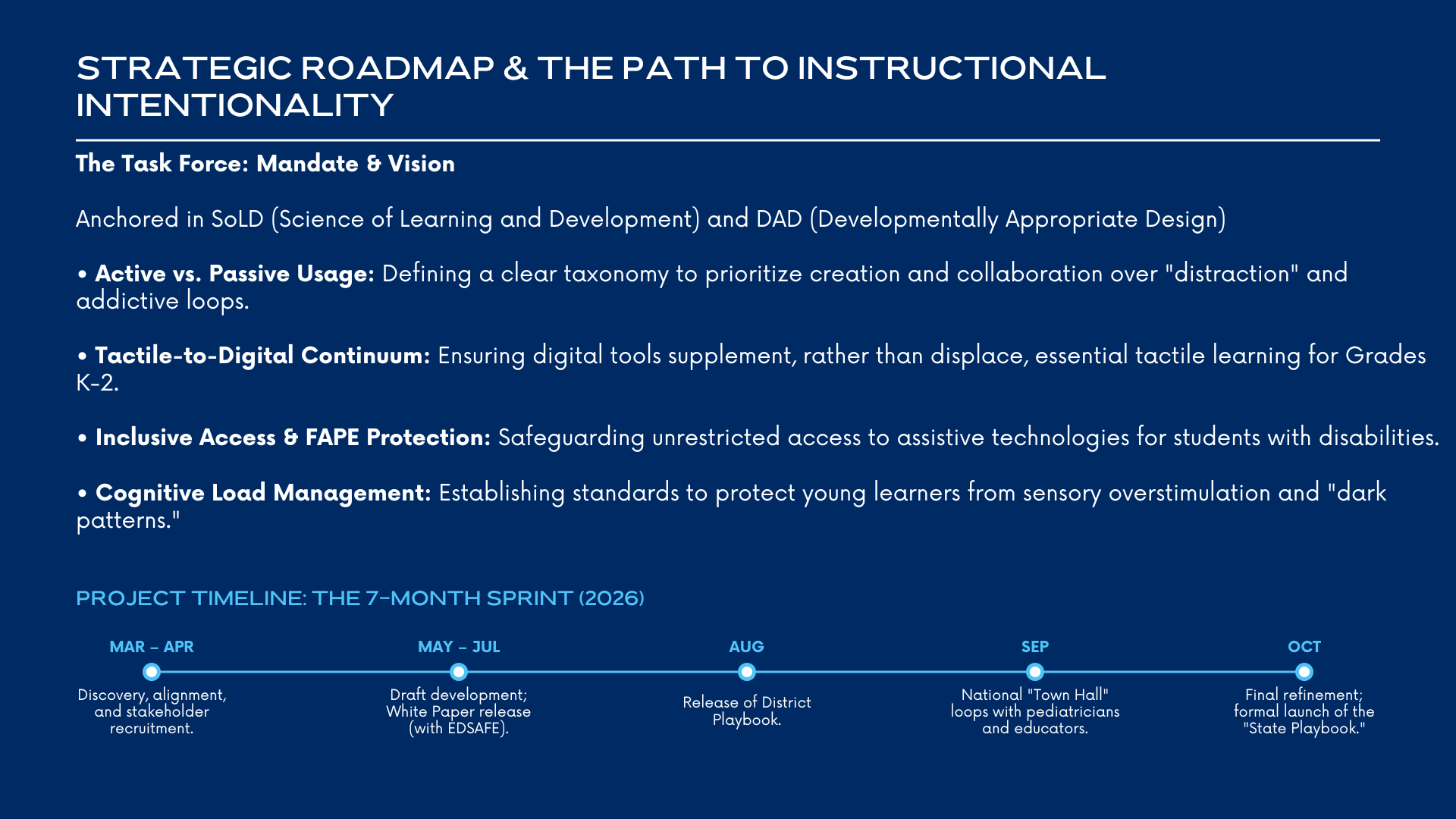
Over the next 7 months, our goal is to prioritize Developmentally Appropriate Design (DAD) to move districts and states beyond reaction prohibition to instructional intentionality. By October 2026, we will release a set of guidance and resources for states and districts.
The State of Play: From "Bans" to "Frameworks"
The legislative landscape is rapidly shifting. Tracking over 40 legislative proposals across the country, we see a macro trend moving away from blunt, statewide restrictions or prohibitions toward sophisticated, state-set guardrails paired with local policy requirements. The Task Force provides the technical and pedagogical expertise to inform hybrid governance between state and local education agencies; targeted restrictions and carve-outs for technologies used for assessment, accommodations, and computer science; and accountability measures for vendor standards, parent transparency, device opt-outs, and state-run quality controls.
The Responsible K-5 EdTech Use Pillars
Centering our work is the development of deliverables built according to our strategic pillars:
The Active vs. Passive Usage Definition: Defining exactly what constitutes "responsible use" (creation, collaboration, and critical thinking) versus "distraction" (passive consumption, addictive loops, and mindless scrolling).
Inclusive Access & FAPE Protection: Explicitly protecting the rights of students with disabilities and multilingual learners, ensuring that the technology required for a Free Appropriate Public Education (FAPE) remains unrestricted and accessible.
Science of Learning & Development (SoLD): All recommendations will be vetted against the core principles of child development, with a priority on active engagement, play, and social interaction.
The "Tactile-to-Digital" Continuum: Establishing a clear framework for the K-5 transition to ensure that technology does not displace foundational tactile learning in grades K-2.
Cognitive Load Management: Developing guidance to protect young learners from "sensory overstimulation" and "dark patterns" in software design.
Key Deliverables
-
A formal framework for state education agencies and school districts to fulfill legislative requirements.
-
Model policy documents
Stakeholder engagement protocols
-
Protocols for ensuring assistive technologies remain unrestricted for IEP/504 compliance.
-
A tool for educators to evaluate the efficacy and evidence based on learning sciences.
-
Educator training and development
Developmentally appropriate EdTech use models by grade band
EdTech Procurement Rubric and Considerations
Governance and Leadership
To support this work, we have assembled an Executive Board of international experts in K-12 education, the learning sciences, industry, and civil rights advocacy to ensure that our work is theoretically and practically viable, evidence-based, and supportive of front-line practitioners.